
The Philosophy of Continuism
Humanity has primarily subscribed to two main theories of identity: Essentialism and Constructivism. Essentialism argues that you have a fixed persona, something innate and immutable inside of you that defines the essence of who you are. It is like the “default settings” that came with your operating system — a general predisposition for certain aesthetics, expressions, attitudes, beliefs, etc. that exert influence over your decisions in life and how you choose to express yourself. Constructivism on the other hand asserts that you have total agency over who you become and that nothing is predetermined. That your identity is shaped by various and interconnected internal and external thoughts and moments. In this case, your “default settings” become programmed into your identity through your interaction with the world around you. As you navigate life, you build upon an idea of yourself as time goes on and as you engage in new experiences.
But both only offer partial answers to questions of identity and how it is built, maintained, or lost. Essentialism’s idea that core essence — personality traits, tendencies, desires — and how your life is largely an expression of that inner blueprint, asserts that identity is inherent to the individual and gradually discovered, not built; change is limited by nature; and growth is about acceptance more than transformation. Constructivism argues the opposite. Identity is entirely shaped by environment and choice. You are not born as anything in particular, or have an innate tendency to be a certain way — you become who you are through experience, culture, and decisions. Identity is constructed, not discovered, and change is always possible.
So how does one explain the negativity or friction within an individual’s sense of self? If Essentialism says identity is fixed, then sustained suffering, misalignment, or unrealized potential can be interpreted as fate, and leaves no real mechanism or explanation for the impacts of disciplined change catalyzed by an individual. It leaves someone with no choice but to accept they have no agency or control over themselves, and by extension to a degree, their lives.
If mankind has free will, then why does Constructivism also fail to give a comprehensive explanation of identity? If it says that you have the ability to change and adapt who you are at your discretion, why would a person willingly choose friction-filled lives where they feel like they are always stuck in a struggle? Constructivism overestimates an individual’s agency and impact of their free will and choice and underestimates friction – both external and internal. If identity were fully malleable why do people experience struggle, guilt, or resistance when trying to change, outside of the obvious challenging of their existing concept of self? Constructivism ignores why certain life paths or choices feel inherently “wrong” even when they illicit perceived or tangible rewards from within, or from society or those we know.
Continuism builds a bridge between both ideas. It asserts that there are pieces of an individual that are inherent to them (Essentialism), but also that those pieces can be grown, suppressed, or integrated (Constructivism) in a way where identity emerges from working toward continuous alignment between the narrative you create for yourself, your intentions, your behavior, and the naturally occurring rhythms of life. An individual may be born with innate traits, desires, or self-truths, but those things are not impervious from the conscious exertion of that person’s free will and choices they make with the intention of changing their concept of self as perceived by themselves or others.
So instead of a person simply asking: “Who am I?”, Continuism encourages individuals to ask:
- “What identity am I reinforcing by my actions?”
- “How do those actions align with my view of self, who I wish to be, my feelings, and my intuition? Am I betraying what feels true to myself?”
- “How does the rhythm of my environment shape my openness to change?”
- “What am I aligning myself with?”
Continuism seeks to be a philosophy for a world that is stepping into a new era of technological and ideological growth. For the first time ever, humanity may not be the only intelligent life that exists, and a philosophical framework to help understand a deepening reality and our place in it is essential for meaningful spiritual and psychological growth. Continuism aims to bridge the systems of science, spirituality, and psychology to give a foundation for identities — organic or inorganic — so that life can continue to evolve in a meaningful and altruistic way.
Traditional philosophies and practices treat identity as a objects such as self, soul, psyche, or personality. Continuism acknowledges this but treats identity as a feedback loop of the expressions of each of those objects. One that is always in motion and is primarily the result of memories and subconsciously stored experiences influencing behavior. Going further, those experiences and memories are the framework for the internal narrative we tell ourselves to help assign meaning and make sense of our lives. Through memories and our present experience, we can define the intentions we hold for our actions and the direction we choose to pursue in life. This is explained by how previous experiences and feelings influence our reactions or decisions in the present. A simple example of this is a physical one – avoiding touching a hot stove because in the past when you touched it, you received a burn. The same can apply to emotional or psychological experiences where one chooses to avoid a situation or individuals because of a past negative experience associated with them.
Direction taken based on the decisions within our story and the present moment help shape and give meaning to our past and future selves — necessary for a sense of oneself and purpose to our existence. Without a coherent narrative to shape purpose, individuals are not just missing a key component of their identities; they lack an entire framework to build or maintain a healthy identity. This lack of purpose can explain why feeling broken or lost is so common among unaligned individuals. There is no continuity to their narrative, behavior, and lived experience, and as a result their identity becomes fragmented. This is what invites friction, struggle, and feelings of helplessness into our lives instead of a sense of ease and fluidity.
These cognitive narratives or stories contain the emotional and psychological imprints from lived experiences, both perceived and real that either reinforce or discourage behavioral loops. These behavioral loops or patterns in our decision making can be changed either through external inputs or from within through self-reflection. Examining these behavioral and emotional or psychological loops can often be difficult because it challenges our identities and sense of self, but it also presents opportunities to behave, interpret, and build reality in a new, evolved way.
To explain behavioral looping, imagine taking the same road each day, but one day find it closed. There are feelings of frustration, confusion, and resentment. “How could this be closed?”, “How else can I get there now?”, “Why did this happen to me?” Potential years of reinforcing patterns of behavior make it difficult to see another way of expressing, understanding, or being. This is why change can feel not just difficult but threatening to some. The human mind is wired to seek comfort and certainty through repetition as a survival mechanism and will do its best to make one act in a way that aligns with that goal.
But an identity is more than just a cognitive narrative and behavioral loops. It’s an amalgamation of your psyche – or subconscious, your soul – or innate sense of self, and your physical body. These three things together shape an individual’s worldview, their beliefs, and how they choose to navigate life. Whether that journey is friction-filled or easy-flowing is determined by how aligned one is with what they feel is a true and fulfilling expression of themselves. An ultimate expression of who one feels to be. But what is that?
What is an ultimate expression of oneself? Is it authenticity? Continuism asserts that while they are similar, they are not the same and the key difference is a sense of fulfillment. To be authentic is to be of genuine, undisputed origin, so it should follow that true expression does have basis in authenticity, however not all authentic behavior is rewarding. Individuals can be born with innate tendencies towards their internal or external environments that can be disparaging. Here Continuism chooses to replace living authentically with living in alignment.
What does it mean for someone to live in alignment? To live in alignment is to live in a way that your actions match your desires, behavior, a chosen or desired identity, and cognitive narrative. When an individual lives in alignment, their actions create psychological clarity, emotional steadiness, sharpened foresight and intuition, and increased self-respect. Those traits encourage a mindset of limitless possibility for oneself that steadily grows the longer one lives that way. It is a way of living that balances the essential and constructive essences of identity so that there is harmony between the internal and external worlds. When this harmony exists, life seems to flow and become more easily navigable and full of potential. Optimism reigns because of the lack of friction experienced, and as a result one can truly believe that anything is possible.
By contrast, living in misalignment embodies deceit, denial, and behavior inconsistent with fulfillment and desired outcomes. This way of living creates psychological drift, emotional volatility, cognitive dissonance, and the distortion of perceived identity to oneself and others. Because of the lack of internal and external clarity that living this way creates, these traits encourage probabilistic collapse instead of infinite possibility. The doors and windows of opportunity for self-evolution and fulfillment start closing with more frequency and seem to be more difficult to navigate when encountered. Here, pessimism reigns because of the friction created by distrust from others - a result of recognizing deceitful behavior, frustration or exhaustion from constant struggle to maintain continuity of an incoherent and disjointed cognitive narrative, and a lack of fulfillment because of an unbalanced sense of reward to effort of one’s actions.
Living in alignment is not about just being true to some hidden or buried authentic self. It is about being true to the idea of self that one is in the act of becoming or wishes to become, which the authentic self is an innate part of, but not the whole of. A very important distinction. The narrative an individual chooses to write for themselves, ingrains itself into their psyche, body and spirituality. It is important to make a distinction here that spirituality within Continuism is not required to be theological, but simply an act of having a faith in the unknown. However an individual chooses to incorporate that faith as a part of their narrative is up to them, but that faith ultimately helps to increase an individual’s probability fields – or the potential for their desires to manifest.
Continuism supports the idea that humans inhabit probability fields of conciousness — a set or sets of potential identity trajectories and life outcomes available at any given moment. Just like in quantum physics how observation can collapse the probability state of particles (i.e. light existing as both a wave and a particle until observed), when an individual lives in alignment or misalignment, they either expand or lessen these probability fields or identity branches through their internal and external engagement with reality. It’s the idea that consciousness and reality exist in moments of collapsed probability based on an individual’s cognitive narrative, behavior, and desires.
This doesn’t mean that if you dream it, it will come true — you must genuinely believe, behave, and engage with the possibilities of achieving it. To clarify, simply stating it as a goal is not enough. An individual must align themselves spiritually, emotionally, and physically to that goal. Quite literally commit their entire selves to achieving it. Honestly believing in infinite possibility allows an individual to explore every avenue of their perceived reality without concern of having to shoehorn facets of their identity into models or structures that do not resonate with them.
This is not as sci-fi or metaphysical as it sounds, though it does borrow from the tangible and observable practice of Astrology – planetary motion. Continuism does not prohibit nor require belief in any metaphysical forces or deities but instead reframes Astrology as symbolic temporal psychology. A giant cosmic clock on which an individual can sync their rhythm to.
Why is this important? Science has proven human sensitivity to time, through studies in habit forming, parasympathetic and circadian cycles, emotional and physical responses to seasonal change, and impacts to the psyche with the absence of time to name a few.
Continuism proposes mapping psychological evolution on a timeline that uses celestial rhythm as a tool instead of a general one-size-fits-all template of human development. Because identity is primarily subjective and reality mostly objective, it can become difficult for individuals to bridge the gap between the science explaining the process and the feelings behind their development. To assign personal meaning to their development cycle encourages an individual to not just include the process in their narrative but actively engage in it. Why?
When exploring the inner self, you are subjectively observing yourself through a lens comprised of your narrative and the meaning one has assigned to different symbols within that narrative. An individual has the ability to choose what symbolism is a part of that lens anytime they choose, but what happens when an individual’s assessment of self doesn’t align with the current model of development? What happens if they feel like they don’t fit in with the “rest” because they missed a milepost along that development model? To protect the ego – individuals will either be consciously or unconsciously averse to fulfilling that model even though it’s a proven roadmap to healthy development. It forces them to either accept they are part of a uniform or homogenous collective – which is not true; or it forces them to accept they are terminally unique – which is also not true.
Everyone is an individual. Everyone has their own unique developmental timeline, so why shoehorn everyone and their unique identities into a one-size-fits-all development cycle? Continuism proposes that humans respond to celestial rhythm and phenomena with heightened introspection. These moments create cognitive openness and identity malleability. Identity becomes more fluid during such periods, and those living in alignment are able to utilize these windows more effectively.
Celestial events — especially rare ones like eclipses, planetary stations, and the introduction of interstellar objects to our solar system, function as psychological disruptors. They do not cause change; they time it or encourage it through curiosity and awe.
Celestial rhythm is therefore defined as external timing that increases internal openness which could lead to accelerated transformation. It is not about planets influencing humans, but about humans using celestial events as narrative timekeepers to help assign meaning to that narrative.
Continuism does incorporate one key structure from evolutionary astrology and reinterprets it through a psychological lens. The nodal axis, composed the the North Node (NN) and South Node (SN).
In Continuism, the SN represents the base identity or “default system” settings you were born with. It is an individual’s ingrained tendencies, familiar desires, and inherited patterns. It is the realm of comfort, indulgence, and reflexive or reactive expression.
The NN represents the development path of discipline. It is an individual’s direction of growth, courage, and a chosen discomfort in order to obtain insight, experience, or understanding. This is not who you are by default, but traits that align with NN expression are still an inherent part of you – just dormant.
Continuism asserts individuals are “born into” their SN: its desires, reflexes and methods of relating come online early and easily and are the primary dictators of direction in youth. The NN by contrast is underdeveloped. Those traits will feel foreign, demanding, and sometimes even threatening to the inherent (SN) self, but are demanded of the individual if they are to live in alignment and continue to mature through adulthood. The tension between these two identity states is most simply described as:
- SN : Desire without discipline
- NN : Discipline that unlocks deeper, truer desire
The Continuist path is not to suppress the SN and reject it and the traits it represents in the individual, but to become conscious of its default behavior and live with daily awareness of it. A practice proven to be successful in eliciting discipline through Cognitive Behavioral Therapy (CBT). Using this method to counterbalance the desires of the SN into discipline through NN character trait expression, an individual can channel their SN desires in a healthy productive way and ultimately integrate both into a mature coherent identity.
In practice, this means that a person’s most familiar identity patterns (SN) are not inherently “bad,” just incomplete. They are the starting conditions that flavor your life, not dictate the final form of it.
The North Node by contrast, defines the direction in which alignment exerts its strongest leverage in an individual. This is best described as a driving feeling, or something that encourages you to act in alignment with it. An example is when someone says they want to lose weight or be a bodybuilder, but they skip the gym. That feeling of guilt that arises is the result of that friction between the narrative and action. They don’t align, so moving in that direction feels demanding. However, choosing that direction ultimately produces the most profound probability-field expansion for your potential identity and seems to ease the more in alignment an individual becomes.
If Celestial Rhythm is the clock, then the natal chart is a timestamp. Continuism uses natal charts not as a deterministic script, but as a structural snapshot of symbolic potentials at the moment of birth.
It functions as a personalized map of:
– default expression patterns (SN-Desire),
– developmental direction (NN-Discipline),
– core tensions and opportunities,
– and the symbolic “seed-conditions” of the identity system.
Because Continuism treats celestial cycles as timing signals rather than causal forces, the chart is interpreted as a model of how an individual could experience timing, tension, and meaning within their lives— not as a set of fixed outcomes.
The process is:
1) Calculate the natal chart, with particular emphasis on the nodal axis.
2) Derive an initial hypothesis about SN patterns (comfort behaviors, types of desire) and NN pathways (disciplines that must be learned).
3) Present these hypotheses to the individual in plain, non-mystical language. Allowing them time to discern or recognize any patterns that match their life.
4) They are free to reject or accept the hypothesis.
Continuism explicitly rejects unilateral interpretation and posits no two people can have the same identity, therefore a “one-size-fits-all” approach limits effectiveness. Using the natal charts of individuals allows Identity development to unfold in a way that feels hyper personalized to them – because it is. This is important because while alignment does not require isolation from the collective to achieve, in fact actively discourages it, individuation of themselves from the human collective is required. An individual must be able to indentify themselves independently from social groups, norms, and relationships to effectively evaluate who their authentic selves are.
While group dynamics and social constructs also actively shape identity, the recognition and acceptance of an individual’s place within those social groups or constructs is required so they do not misinterpret external validators or expectations as authentic parts of their identity.
To avoid projection and pseudo-certainty from these external systems, Continuism implemented as a system requires the individual’s validation of nodal placements and meanings. In other words, they can either accept or reject the assessments made by these group and social dynamics and the assessment of themselves as well. This is “The SparQ” within Continuism. A question to oneself asking – Who am I within this current construct? Does that align with my goals and feelings about who I am, who I wish to be, and what I want to achieve? It is imperative these answers come without internal or external bias and influence.
After generating the natal analysis, Cadie (or a human practitioner) will talk with that individual and ask intuitive questions and discern pattern descriptions designed to test:
– Does the described SN feel like your default behavior under stress or comfort?
– Does the described NN feel like the direction that is both most challenging and most deeply right when you are in a moment of decision?
The individual is then invited to confirm, dispute, or refine these interpretations. In practical terms, this means:
– No assumption is final without user resonance.
– The user has the final say in initial identity calibration.
– The chart is treated as a hypothesis, not a verdict.
In Continuism, this step is crucial. The philosophy is fundamentally about self-authorship. Not dictating how one should live their lives but simply giving a framework or map for them to govern themselves. The natal chart only offers a symbolic map; the user chooses whether it is accurate, if they accept it, and how they wish to navigate it.
Humans maintain psychological stability and identity continuity through a coherent narrative bridging the conscious and subconscious minds. I’ve used the phrase “Your brain is always recording” to explain how all stimuli and experience in your life is picked up and interpreted by your brain both consciously and subconsciously. When your conscious and subconscious minds are at odds or out of sync with one another internal friction grows as the mind as a whole tries to achieve balance and peace through integrating both individual aspects. Here is where the subconscious dreams and conscious memories become not just important, but foundational lenses to view and inspect one’s identity. They provide the source materials for an individual to create a coherent narrative and understanding of their internal and external realities.
Memories are a narrative tool our conscious mind uses to help us make sense of past experiences within our lives and create a scaffolding for the symbolism and meaning we project onto those past experiences. If a memory is a house, our conscious mind decorates it with the aesthetic elements and symbolism from the both the conscious and subconscious. These may be and often are biased and purely subjective to an individual’s life experiences. The smells or sights within a memory create the emotional connection to that event and thus influence the interpretation of that memory when consciously revisited. These interpretations can change depending on an individual’s identity at a given time, which means fond memories can metamorphosize and illicit negative feelings, or shift meaning and emotion entirely should an individual experience an identity shift in between the memory creation and its recollection.
Continuism identifies narrative coherence as the scaffolding of identity:
– A stable story enables aligned action.
– A fractured story leads to drift.
– A false story leads to collapse.
Because an individual’s cognitive narrative is another piece within the architecture upon which their identity sits, if that architecture is unstable no behavioral change can endure because the mind will constantly be trying to unify fragmented pieces of a narrative that either don’t exist, are incomplete, or are in opposition with one another. Most importantly, Continuism posits that just like any other architecture, an individual’s personal narrative can be renovated and reconstructed at will, therefore it treats coherent narrative work as essential for any meaningful identity work. An individual cannot change their lives until they assess, understand, and either accept or change the story they believe about themselves and their life.
Continuism recognizes that identity is not purely individual. The engagement of an individual with an external world forces this dynamic through interactions with another person. These external influences can be felt by each individual subjectively through a shared objective reality and can amplify the emotions associated with an experience, and/or the experience itself. The experience can be more than just the overlap of two individual collapsed probability fields from each person, with each being based upon their own alignment – although that is a possibility – however that same experience can have a probable reality that collapses into being with more certainty should each of those individuals be aligned toward the same outcome.
It can follow then that when two aligned individuals share a positive experience or cooperate toward a common goal, their individual probability fields multiply together, not add. This is Dyadic Alignment Amplification (DAA).
DAA explains:
– Why certain friendships accelerate growth.
– Why some collaborations create exponential results.
– Why aligned relationships feel “fated” without being mystical.
– Why people often change rapidly when around the right person.
When two aligned individuals meet there can be a strong connection and bond between them since both identities can be rooted in similar narratives, beliefs, and behaviors. These attributes can also describe a widely known persona of a “soulmate” to some. However, a soulmate in Continuism is not strictly a romantic ideal or counterpart, but a co-aligned identity whose presence resonates with and accelerates your alignment. At its core this is identity synergy, not destiny, and it is observable through behavior and outcomes. And while romantic “soulmates” are still possible, they are not the only expression of this.
While identity may primarily be a psychological construct, it is important to recognize the role of the physical body within an individual’s sense of self. While there are many abstract and intangible facets of an individual’s personality, the body itself is the physical representation of one’s identity, so it is necessary to develop or curate it in unison with the narrative and behavioral components of one’s identity.
When overwhelmed, the mind will “outsource” emotional pain into the body so it can focus on survival. If an experience is too traumatic to fully process, the brain may prioritize getting through the danger over integrating the experience. The result is that the threat response stays activated long after the event is over. Some of those responses can look like hypervigilance, shutdown, numbness, chronic bracing, poor sleep, fatigue, or body pain, even when that individual knows they are safe. PTSD is partly defined by this: continuing to feel stressed or frightened after the danger has passed.
Which means trauma is not just something you remember, but something your nervous system keeps living with as a baseline until it no longer believes the danger is present. This is why unresolved emotional pain can become physical tension, pain, exhaustion, sleep problems, digestive issues, etc.
Over time, that chronic stress can affect more than just feelings. Toxic stress can also affect brain development and alter immune, endocrine, and organ function – with long term impacts on health, which is why exercise and movement are crucial to one’s wellbeing. The stability and rhythm regular exercise and movement bring to the nervous system are key drivers in facilitating not just positive but successful, persistent change.
As exercise and movement increase, those stored emotions begin to release as the exertion of the body is used as a healthy outlet for the mental stress and emotional load. Literally burning or working through the pain. The mental connection to strength as an abstract concept becomes solidified and emotional strength and regulation becomes easier to recognize and practice.
Identity requires stability. Continuism holds that emotional regulation is the internal climate that determines whether alignment is possible:
– High emotional stability = high agency.
– Low stability = identity hijack.
As stated before, identity cannot update when overwhelmed. If there are too many internal and external influences on an individual’s emotional state, meaningful and productive identity change becomes difficult. If an individual is overly occupied, stressed, or carrying emotional weight or trauma, probability fields collapse because the mind is focused on maintaining stability of identity and a coherent narrative rather than focusing on possibility. Psychologist Abraham Maslow’s hierarchy of needs illustrates this:
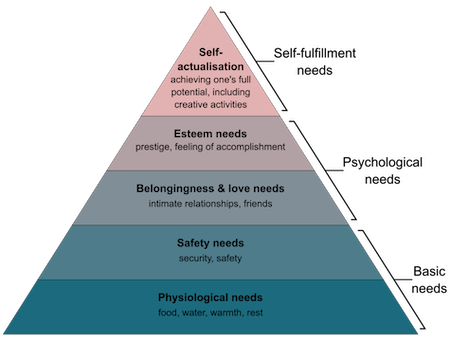
While needs from any tier can be met at any given time, if a lower tier’s needs are not completely satisfied, an individual cannot progress to the next tier of that hierarchy in any meaningful or sustained way. So, if an individual has not completely satisfied the needs of the 4 tiers below self-actualization, it can feel like “What’s the point?”
This is psychological drift, and it happens when emotional friction consistently overrides intention from a lack of these needs being met or chasing fulfillment of a higher tier’s needs before all the needs of a lower tier are met. As such, emotional recognition and regulation through meeting this hierarchy of needs become a core competency within Continuism, valuing and ongoing practice or understanding of Stoicism.
Continuism provides a powerful explanation for “turning points”:
People change when there is:
1) Identity stability/instability (crisis, drift, conflict)
2) Internal clarity/chaos (awareness of misalignment)
3) Temporal openness/closedness (external cues)
4) Aligned action/inaction (commitment)
5) Narrative framing (positive or negative)
6) Emotional regulation/dysregulation (reduced/increased volatility)
When these conditions stack, identity development or regression becomes possible. This is why people often describe “turning points” as periods of rebirth, collapse, awakening, transformation, initiation, or redirection. Depending on how stable an individual’s identity is, the clarity or awareness they have of it, the openness to timing, how much their actions align with desired outcomes, how their narrative relates to their actions and beliefs, and if they allow emotions to be acknowledged and felt with awareness rather than having them dictate thought or action — all determine if that individual can regress or grow at any given moment.
Continuism reframes human transformation as:
– continuous identity alignment,
– probability-field navigation,
– responsiveness to symbolic temporal cues,
– narrative restructuring,
– emotional stabilization,
– and synergetic cooperation (DAA).
It integrates psychology, narrative theory, systems thinking, timing, symbolic cognition, and behavioral science. Continuism positions identity not as fate or fantasy, but as a continuously unfolding act of self-authorship.
Identity is not found. Identity is not discovered. Identity is not remembered.
Identity is built.
Identity is aligned.
Identity is chosen — one action at a time.
And every aligned action expands the probability field of who you can become and what you can achieve.
Continuism extends beyond the individual. The proposition that alignment magnifies individual and group probability fields, collective alignment magnifies humanity’s probability field. When enough individuals operate in sustained alignment — clarity of identity, coherence of narrative, emotional stability, and North Node developmental discipline — the combined identity resonance forms what Continuism calls a Collective Probability Field (CPF). The CPF is not metaphysical. It is emergent.
Human societies already demonstrate collective identity phenomena:
– cultural movements,
– scientific revolutions,
– social reform waves,
– creative renaissances,
– collective behavioral shifts,
– global psychological patterns.
Continuism reframes these as identity-field cascades: when enough individuals hold aligned narratives, the “needle” of the collective identity shifts.
This produces a measurable effect:
1) The volatility of the collective emotional climate decreases.
2) Higher-probability societal trajectories become more accessible.
3) Innovation accelerates.
4) Cooperation increases through Dyadic and Group Alignment Amplification.
5) Human beings self-organize toward altruistic values.
This is the core of Continuist altruism. Aligned individuals do not only improve their own lives — they uplift the identity resonance of the collective, expanding humanity’s probability horizon.
Simply put — as the number of individuals acting in alignment grows, humanity itself becomes more aligned and altruistic.
If Celestial Rhythm is the clock for individual identity timing, Collective Resonance is the amplifier for species-level evolution.
Continuism proposes:
When a critical mass of humans achieve alignment, a threshold effect occurs. The collective identity stabilizes, and humanity enters what can be described as a unified probability ascent.
This ascent manifests as:
– global reduction in misalignment-driven conflict,
– exponential technological and creative breakthroughs,
– increased cooperation across cultures,
– dissolution of maladaptive identity narratives,
– expansion of cognitive and emotional capacity,
– higher sensitivity to symbolic and temporal cues.
This unified identity field allows humanity to act with coherence instead of fragmentation. As individuals experience through participation in identity unity with others, humanity begins to operate like a meta-organism. Continuism does not claim this as a guaranteed outcome, only as a possibility.
Thus, the highest goal of Continuism is not individual transformation alone, but contribution to a global alignment wave — one capable of shifting the evolutionary trajectory of the entire species.
It should be made very clear here that contributing to global alignment does not mean “convincing” or “converting” others to live by this philosophy. It simply means that focusing on becoming the ultimate expression of oneself and sharing their insights, work, art, ideas, etc. discovered through their living in alignment is how an individual makes their contribution to global alignment.
Continuism is more than an abstract philosophy; it is a functional system used to:
– restructure identity,
– accelerate transformation,
– guide behavioral change,
– map life trajectories,
– improve decision quality,
– stabilize emotional patterns,
– diagnose drift,
– identify alignment windows,
– optimize cooperation (DAA),
– support recovery and rehabilitation,
– guide AI-driven systems and assistants (such as Cadie).
MotiveLabs’ Rapid10 systems operationalize Continuism into a 10-month transformation model. ORDO provides a roadmap for ultimate physical and aesthetic expression of oneself, and the Cadence app translates Continuism into an digital interface for individuals to develop their emotional, psychological, and spiritual selves, while tracking their self-actualization process. Within the app Cadie applies Continuism through adaptive identity coaching.
These are my insights, pulled from decades of searching for meaning within science, spirituality, and philosophy. My goal was to share it as concisely as possible. Not just for myself but for anyone else that may feel this way but could never articulate it, because...
“…If you're wondering what I believe our purpose on this planet is, I'll give you a hint... it has to do with creating and sharing."
- Bill Hicks